

Introducing our School's new mission statement and strategic plan

Read our strategic plan here:
Read our implementation timetable:
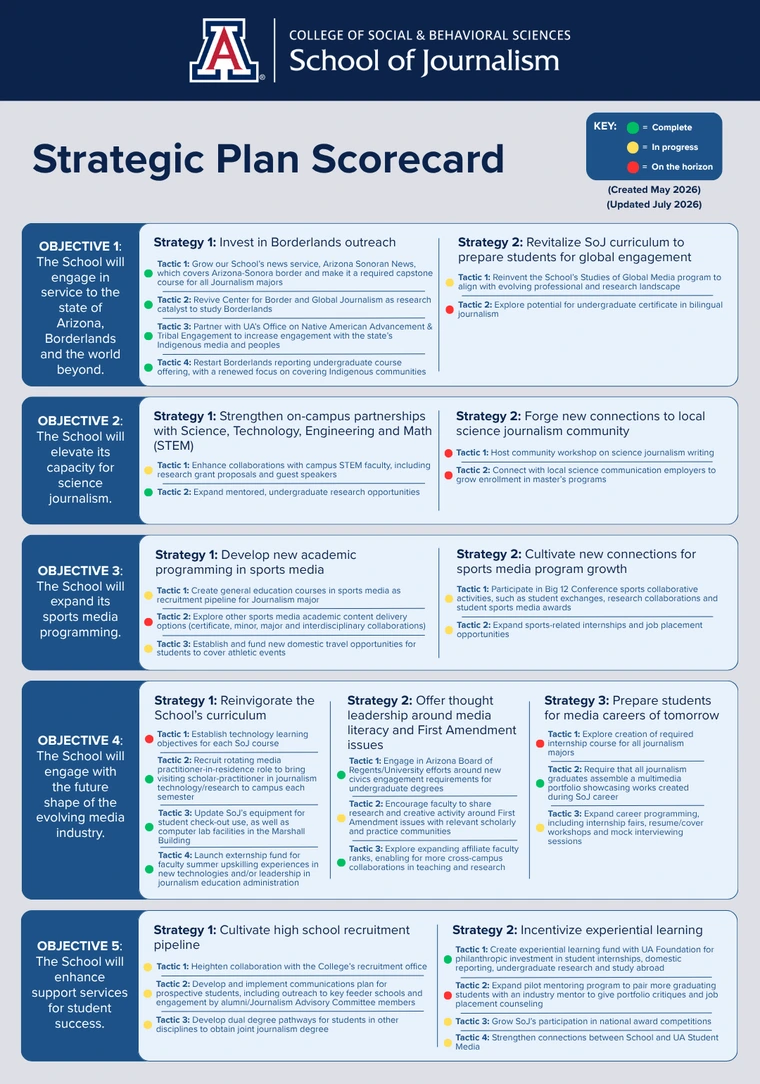
STRATEGIC PLAN SCORECARD
This scorecard enables our School to be publicly accountable for the progress we make on implementing the strategic plan. We will update this scorecard annually.
Why create a new strategic plan?
A strategic plan is a living, evolving artifact that organizations use as their North Star when working in the direction of their short and long term goals. An uncertain political, social and cultural future coupled with rapidly advancing technology is disrupting every industry, higher education included. In the past few years, journalism school enrollments have dropped across the nation. Artificial Intelligence is transforming higher education’s role in students securing a job. At the same time, budgets are increasingly tight. All of these factors mean that it is time for the School of Journalism to update its strategic plan. Our School must chart its future direction, its strengths and how to best leverage them. We must adapt to face these new challenges and become an innovative place for educating and training future journalists and media communicators.

How we built our strategic plan
To this end, creation of our plan began in Summer 2025. In July-August 2025, the School’s Director began a “Local Media Listening Tour” to build connections within the journalism community, while better understanding the unique needs of employers, alumni and external stakeholders associated with our School. As part of the tour, the Director -- joined by members of the faculty -- made site visits to all three television affiliates (KGUN, KVOA and KOLD), as well as visits with Arizona Public Media (the region’s PBS/NPR affiliate), editors of the local newspaper (The Arizona Daily Star), regional weeklies, several digital-only news nonprofits and other journalism-adjacent organizations in Tucson, including those in sports media. These conversations solidified that we need to thoughtfully approach the evolving media environment, so that we can best prepare our students to seek employment and success after graduation.


Informed by the “Listening Tour” engagement, faculty and staff brainstorming for the plan then took shape at our annual retreat, hosted in mid-August 2025. Representatives from the School’s Journalism Advisory Council (JAC) -- a 19-member appointed body populated by industry experts and alumni -- were also invited to participate in strategic plan brainstorming at the retreat. The session began by sharing projected undergraduate and graduate enrollments for the fall semester. The faculty and staff team also learned about the institutional budget, as well as key findings from the School’s ACEJMC accreditation review in Spring 2025. Finally, the team discussed the College’s strategic plan and the University’s new strategic plan, “Delivering on our Promise,” which is centered on a set of three “Strategic Imperatives”:
- Success for every student;
- Research that shapes the future;
- Engagement with our communities to create opportunity.
The retreat ideation session continued with faculty/staff members brainstorming challenges facing the news industry and facing our School of Journalism. Faculty members were then introduced to the key elements of a strategic plan --- including: objectives, tactics, metrics and timetables for accountability. In the next segment of the retreat, faculty and staff members were asked to identify strengths of the School, weaknesses of the School, opportunities for the School’s future growth and potential threats to the School’s success. After the whiteboard ideation exercise, faculty and staff groups reported their findings to the entire assembly, identifying core points for future growth.
The strategic planning process continued with consultation from the University of Arizona Eller College of Management. Bob Sweo, a faculty member in the Eller College with significant professional expertise of constructing strategic plans, visited the School’s faculty/staff meeting in September 2025 to explain how strategic plans are constructed and how they provide value to an organization. Eller College personnel served as consultants for the University’s recent institutional strategic planning exercise, as well as the long-range planning conducted by University of Arizona Athletics.
At this stage, a Long-Range Planning (LRP) Committee was created to synthesize the retreat and faculty meeting insights into a draft strategic plan for group consideration. The School voted on new bylaws in September 2025 to make the LRP Committee a permanent standing committee of the School. As a result, this group will continue to guide the plan’s implementation in the next five years. This Committee has representation from key School stakeholders (tenure-track faculty, career-track faculty, staff, Advisory Council members, alumni and students). At this stage, the School’s administrative associate collected public-facing strategic plans from ACEJMC-accredited institutions, which were shared with the LRP Committee.
The Committee’s initial meeting in September 2025 centered upon discussing the draft mission statement and core areas for the School’s strategic investment. In October 2025, the Committee reconvened to discuss the draft strategic plan. At this point in the process, the draft strategic plan was also shared with the School’s Advisory Council for feedback in a special meeting on Oct. 24, 2025. The School’s Director also shared the draft plan with the College of Social and Behavioral Sciences Dean’s Office in October 2025, to make sure there is alignment on the plan’s trajectory. This draft plan was brought to the School’s faculty and staff meeting for initial discussion on Nov. 3, 2025. After that initial draft was refined, the final plan was voted upon by the faculty on Nov. 12, 2025 with unanimous support.


Constructing the mission statement
Mission statements usually comprise philosophical values and aspirational goals of an organization (Vogts, 2023). Almost all journalism schools across the United States have mission statements, serving as an indication of what the school believes it stands for, its purpose in a university and the community of which it is a part, and its duties towards students, the academic institution and the journalism and media field (Christ & Hynes, 1997). To create a successful mission statement, research suggests the document’s architects must include how an institution sees itself, how it wishes for others to see it, who it is serving, what it is offering, and how it plans to not just survive but thrive in the future (Pearce & Fred, 1987). For Journalism schools and educators, however, mission statements take on additional importance as they try to stay true to their identity while accommodating market demands (Vogts, 2023) such as audience studies, independent news media startups, the use of AI in news writing and increasing demand for sports and social media communication, compared to traditional political and local news.
To start the School’s strategic planning process, we created a mission statement. At the School’s retreat, all faculty and staff members in attendance were asked to highlight a single word or phrase that described and differentiated our School. During this exercise, faculty and staff were instructed to keep in mind the rapidly-developing nature of the journalism field. As a result, the mission statement takes into account the ever-evolving industry and the future career trajectories that our graduates may take. The Director then took these words highlighted by faculty and staff and crafted three, initial mission statements, incorporating the key terms derived from the group exercise. The draft statements were circulated to faculty and staff by email, who then refined the focus of each statement electronically. The mission statement was then further refined by members of the School’s LRP Committee, which included local news industry leaders. The Director then circulated a Qualtrics survey, in which faculty and staff voted upon the overall direction of the draft mission statement. This draft mission statement received majority support from our faculty (an electronic vote of 10-2). The Long-Range Planning co-chair gave an update on the mission statement’s development at the School’s Oct. 6 faculty meeting. The draft statement was further refined, based upon the feedback received via Qualtrics. The final mission statement was presented to faculty at its Oct. 24, 2025 meeting and received unanimous support.
OUR MISSION
The University of Arizona School of Journalism is committed to digital-first storytelling using innovative technologies underscored by bedrock ethics. We train our students to create content that accurately reflects the community, culture and commerce of Southern Arizona, as well as develop scholarship that helps our region better understand itself.
Flowing from this mission statement, our School has a set of three primary goals in educating our students:
- Goal #1: Training students in the digital-first storytelling approaches and technologies that they will encounter on-the-job;
- Goal #2: Providing students foundational ethical and legal principles to guide their work;
- Goal #3: Connecting students to the communities that they serve.
OUR STRATEGIC PLAN
The theme for our 2026-2030 strategic plan is “A Diamond in the Desert.” We chose this theme because the School will celebrate its 75th “diamond anniversary” in 2026. We also believe that this theme connects to the School’s status as an “undiscovered gem” or “jewel” of a journalism school. SoJ staff worked with the University’s marketing and communications unit to design a logo to help brand the plan, both externally and internally.
Aligning with the diamond shape, we identified four verticals for the School’s future growth, alongside an overarching need to focus on the student experience:
- Service to the state (particularly coverage of Borderlands);
- Science journalism;
- Sports journalism;
- Shape of the industry (particularly technological change/disruption);
In crafting the plan, our team placed intentional focus on making sure that the plan is responsive to enrollment trends within journalism and mass communication education, as well as the dynamic conditions within the news industry itself, when it comes to the role of technology in news production and consumption.
We will review this plan annually for alignment with implementation (see scorecard above), as well as technological change in the industry. Each spring semester, the Long-Range Planning Committee will compile an annual report of how the plan tactics have advanced in alignment with metrics described in our implementation timetable. This report will be shared at the School’s annual faculty and staff retreat every August, in which the team will identify any strategies or tactics that need additional attention. At the same time, we will refresh the plan annually, should any new environmental conditions surface.