

Students Expand Environmental Journalism Expertise at SEJ Conference in Chicago

Journalism student Summer Williams photographs wildlife on a tour of the Nature Conservancy's Nachusa Grasslands in Illinois.
Photo by McKenna Manzo
University of Arizona School of Journalism students Arilynn Hyatt, McKenna Manzo and Summer Williams attended the 2026 Society of Environmental Journalists (SEJ) conference hosted in Chicago this spring. The students gained hands-on experience in environmental reporting, multimedia storytelling and solutions journalism.
The four-day conference featured educational workshops, panel discussions and networking opportunities focused on environmental issues, including climate change, water scarcity, data centers’ energy and water use, PFAS contamination and the role of journalism in helping communities understand complex challenges.

Graduate student McKenna Manzo takes notes during a tour of the Nature Conservancy's Nachusa Grasslands.
Photo by Summer Williams
“The panels were great for learning different perspectives and techniques for doing better reporting in terms of not just looking at environmental problems as isolated issues, but seeing all the interconnected threads between them and social justice or the economy,” Williams said.
One session that stood out to Williams focused on the Colorado River and growing concerns of water shortages in the Southwest.
“This is an environmental issue, but it’s also people’s livelihoods,” Williams said. “There are so many facets of these stories when you dig deeper and really connect with the stakeholders and communities affected.”
On the second day of the conference, the students boarded a bus early in the morning and traveled west of Chicago for a tour of the Nature Conservancy’s Nachusa Grasslands, where they spent the day hiking and learning about restoration efforts.
“We got to see the bison they have out there, all the different plants and animal species and learn from the people who work there,” Manzo said.

A bison at the Nature Conservancy's Nachusa Grasslands.
Photo by McKenna Manzo
Hyatt attended a session on making complex environmental issues easier for audiences to understand through social media.
“With everything being so digital now, there is an information overload,” Hyatt said. “Teaching people how to find exactly what they need to know is so important.”
SEJ also offered sessions on solutions journalism, or reporting that focuses on responses to a problem and their effectiveness rather than the problem itself.
“Solutions stories aren’t always good, happy news but can also be stories that hold institutions accountable,” Manzo said. “I learned the importance of solutions journalism for starting conversations.”
One of the biggest takeaways for Manzo was learning how stories can serve as a call to action.
“Solutions journalism should allow people to read a story and think, ‘I could take this and frame it to my community and replicate that solution in a way that works for me,’” she said.
The conference also gave students the opportunity to learn how environmental journalism extends beyond traditional science reporting. Williams attended sessions focused on photography and documentary filmmaking, while all three students emphasized the accessibility of environmental reporting.
“You don’t have to have a science background to appreciate environmental journalism or the environment,” Manzo said.
“There are science and environmental stories in any kind of beat,” Hyatt added. “You just have to look through that lens and report on how those issues affect your own community. Anyone can do it.”
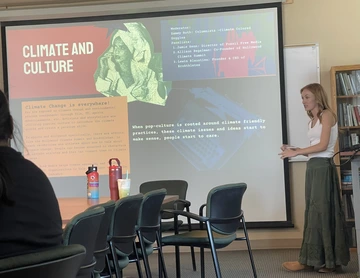
Arilynn Hyatt speaks about her experience at the 2026 Society of Environmental Journalists conference during a presentation on May 1, 2026.
Hyatt, Manzo and Williams are members of the School of Journalism’s student chapter of SEJ and previously attended the organization’s 2025 conference held at Arizona State University as part of SEJ’s student newsroom.
After returning from Chicago, the students shared highlights in a seminar, where the students reflected with School faculty, staff and classmates on how the experience will shape their future work.
The School of Journalism is heavily investing in science and environmental coverage, which is a core vertical in the school’s new strategic plan. In the coming year, school faculty and students will have enhanced travel resources to attend more conferences like SEJ, as well as reporting events, to grow their skills.
“The biggest point of all of our jobs is to create a resource for people so they know what to do and can stay informed,” Williams said.